
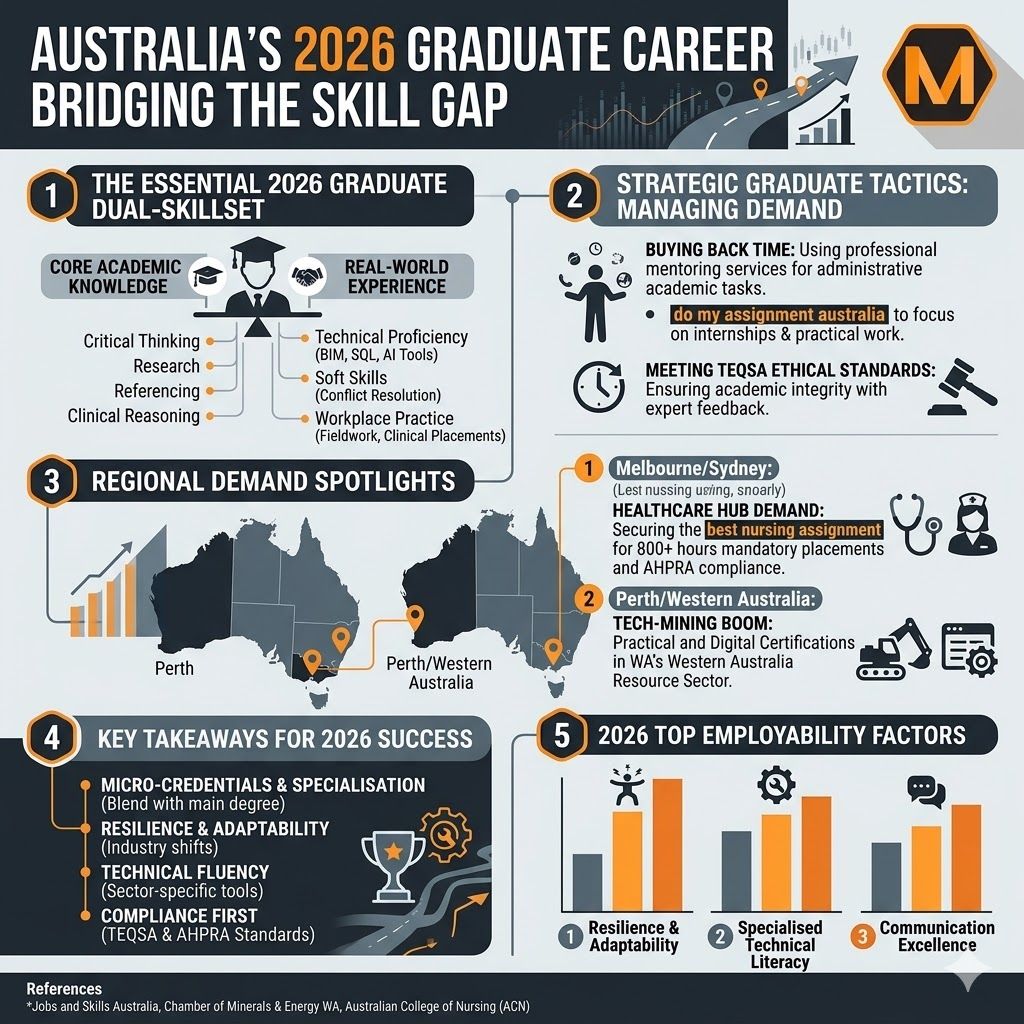
Bridging the Skill Gap: How Australian Graduates are Navigating 2026 Career Demands
The Australian professional landscape in 2026 is no longer defined by the traditional “degree-to-desk” pipeline. As the nation grapples with a persistent skill shortage across critical sectors, the definition of a “work-ready” graduate has undergone a radical transformation. With Jobs and Skills Australia reporting that roughly 90% of new roles now require post-secondary qualifications, the pressure on the Class of 2026 to deliver immediate value is unprecedented.
The New Currency of the Australian Job Market
For today’s graduates in Sydney, Melbourne, and Brisbane, academic excellence is merely the baseline. The real competitive advantage lies in “Micro-Specialisation”—the ability to blend a primary degree with niche technical fluencies like AI literacy, data analytics, and industry-specific compliance.
Current market data from early 2026 indicates that nearly 42% of graduates are now integrating AI tools into their workflows to manage the administrative burden of their roles. However, this shift creates a paradox: while technology handles the volume, the demand for high-level critical thinking and “human-centric” skills—such as emotional intelligence and clinical reasoning—has reached an all-time high.
To maintain this delicate balance, many high-achieving students are adopting a “Project Management” approach to their education. By choosing to do my assignment australia for foundational units, they effectively buy back time to focus on high-stakes practical placements and professional networking. This strategic delegation allows them to meet the rigorous TEQSA (Tertiary Education Quality and Standards Agency) benchmarks of 2026 while simultaneously building a portfolio of real-world experience.
Local Case Study: The Western Australian Resource Boom
In Western Australia, the shift toward “Digital Mining” has created a unique micro-economy. Graduates in Perth are no longer just expected to understand geology or engineering; they must be proficient in remote operations and autonomous systems. According to the Chamber of Minerals and Energy of WA, the 2026 talent gap in “Tech-Mining” is expected to reach 15,000 workers. Students in these regions are increasingly prioritising field-work and site certifications over traditional library-bound research, utilising specialised academic support to ensure their technical reports meet the high safety and environmental standards required by the WA Department of Mines.
See also: The Future of Cybersecurity Technologies
Sector Spotlight: The Healthcare Frontier
Nowhere is the skill gap more visible than in the Australian healthcare sector. Recent reports from the Australian College of Nursing (ACN) warn of a projected shortfall of 70,000 nurses by 2035 if current retention and training trends do not shift.
For nursing students, the 2026 requirements involve more than just patient care; they include navigating complex NDIS frameworks and AHPRA-mandated clinical standards. The intensity of these programs means that securing the best nursing assignment help is often a necessity for those managing 800+ hours of mandatory clinical placement. It ensures that their academic submissions reflect the “Clinical Reasoning Cycle” required for modern registration, without sacrificing their mental health or practical performance.
Data-Driven Trends: 2026 Graduate Employability
According to the 2026 AAGE (Australian Association of Graduate Employers) Survey, the top three factors employers look for are:
- Resilience & Adaptability: The ability to pivot as industry regulations change.
- Specialised Technical Literacy: Proficiency in sector-specific tools (e.g., BIM for Engineering, SQL for Finance).
- Communication Excellence: The capacity to translate complex data into actionable business insights.
Key Takeaways
- Dual-Skillset Requirement: Success in 2026 requires a mix of “Human Skills” and “Digital Fluency.”
- Regional Demand: Specialised sectors like WA’s mining industry require local, tech-forward knowledge.
- Time as a Resource: Top graduates delegate administrative tasks to focus on industry-aligned placements.
- Healthcare Dominance: Nursing remains the most secure career path with the highest growth potential through 2030.
Frequently Asked Questions (FAQ)
Q: What are the most in-demand skills in Australia for 2026?
Beyond core degrees, employers are prioritising AI literacy, data-driven decision-making, and soft skills like conflict resolution and clinical reasoning.
Q: How has the 2026 TEQSA update affected assignment standards?
TEQSA has increased focus on “Academic Integrity.” Submissions must show clear evidence of original critical thought and adherence to updated Australian referencing styles (APA7/Harvard).
Q: Why is nursing considered a high-growth career in the current market?
Due to an ageing population and a push for nurse-led primary care clinics, the government is heavily investing in the sector, creating thousands of new roles for Registered Nurses.
About the Author
Lachlan Miller is a Senior Academic Strategist at MyAssignmentHelp.services. With over a decade of experience in the Australian EdTech sector, Lachlan specialises in aligning academic support with the latest TEQSA standards and Jobs and Skills Australia frameworks. He has helped thousands of students navigate the transition from tertiary education to high-growth professional careers.
References
- Jobs and Skills Australia (2026). “Annual Labour Market Outlook.”
- Australian College of Nursing (2026). “Pre-Budget Submission 2026-27.”
- Chamber of Minerals and Energy of WA (2026). “WA Resource Sector Talent Report.”
- AAGE (2026). “Graduate Candidate and Employer Survey Results.”