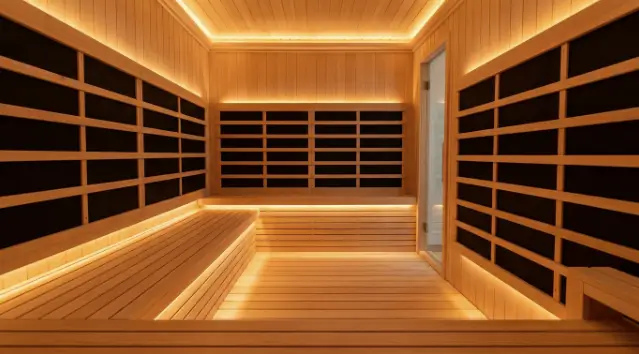
Electric Infrared or Wood-Fired Heat: How to Choose Your First Home Sauna
Electric infrared panels and a wood-fired stove heat you in fundamentally different ways: infrared warms your body directly through carbon or ceramic panels plugged into a standard outlet, while wood heat warms the air and stones in the cabin using an open flame that needs fuel, venting, and active tending. For a first home sauna, the choice usually comes down to how much hands-on ritual you want versus how much simplicity and lower upkeep matter to you. Here’s how to work through that decision step by step.
Step 1: Check What Power or Fuel Access You Actually Have
Start with what your property can support before you fall in love with either option. Infrared cabins draw around 1.5 kW for a two-person unit, which fits comfortably on a standard 120-volt, 15 or 20-amp household circuit, often the same outlet you’d use for a shop vacuum or a window air conditioner. Wood-fired stoves need no electrical hookup at all, but they need a reliable source of properly seasoned firewood, storage space to keep it dry, and a spot where smoke venting and chimney clearance from any structure won’t create a code or neighbor problem. If you’re in a dense neighborhood or an HOA with restrictions on open flame or smoke, that alone can settle the decision toward infrared before you even compare anything else.
Step 2: Decide How Much Maintenance Ritual You Actually Want
A wood-fired sauna is a hands-on experience by design. You’re splitting or buying wood, building a fire, monitoring it while the stones heat, and cleaning ash out afterward. Plenty of people genuinely enjoy that process as part of the ritual, the same way some people enjoy tending a fireplace rather than flipping on a gas insert. An infrared cabin strips almost all of that out. You plug it in, set a timer, and the panels do the rest, with cleanup limited to wiping down a dry interior since there’s no steam or ash involved. If your honest answer is that you want to use your sauna often and won’t stick with a routine that takes extra prep time, the lower-maintenance infrared side usually wins out in practice, even if the wood-fired version sounds more appealing on paper.
Step 3: Compare Warm-Up Time and Session Length
Infrared panels typically bring a cabin to a comfortable 120 to 150 degree operating range in 10 to 15 minutes. A wood-fired stove needs 30 to 45 minutes to properly heat both the stones and the surrounding air to the higher 170 to 195 degree range traditional sauna bathing is built around, and that’s after you’ve already spent time building the fire. Session length differs too: infrared sessions typically run 30 to 45 minutes at the gentler heat, while wood-fired sessions are often shorter, 15 to 20 minutes, at a more intense temperature. Neither pace is objectively better, but if you want to decide to use your sauna and be sitting in it within 15 minutes, infrared’s shorter total wait time is the more realistic option for a weeknight routine.
Step 4: Weigh the Upfront and Ongoing Costs
A quality two-person infrared cabin generally lands between $2,500 and $4,500, plug-in ready with no electrician visit required in most cases. A wood-fired traditional cabin can start similarly but often climbs higher once you factor in the stove itself, chimney installation, and any site work for proper clearances, sometimes landing well above $5,000 for a larger build. Ongoing costs split differently too. Infrared’s electricity draw is modest, often 15 to 30 cents per session, while wood-fired heat depends on local firewood prices and how often you use the cabin, and a full cord can run anywhere from $150 to $400 depending on your region and wood type.
Step 5: Factor In Noise, Smell, and Everyday Ambiance
This part gets overlooked in most cost comparisons, but it affects how often you’ll actually use the sauna. A wood-fired stove ticks and crackles as it burns, and the smell of wood smoke lingers faintly on clothing and skin afterward, which some people love as part of the experience and others find they’d rather avoid on a weeknight before bed. Infrared panels run silently and produce no smoke or combustion smell at all, since there’s no open flame involved, just the panels themselves warming up. If you’re planning to use the sauna right before sleep or early in the morning before work, that quiet, scent-free operation is worth weighing alongside the cost numbers, since the format you’ll actually reach for on a tired Tuesday matters more than the one that sounds better in theory.
Step 6: Think About What You’re Actually Trying to Get Out of It
If your main goal is a gentler, lower-temperature sweat session with minimal setup and cleanup, and you like the idea of low-EMF panel technology and a quiet, dry cabin, infrared is the more practical everyday choice for most beginners. If you’re drawn to the ritual of building a fire, the more intense heat traditional bathing is known for, and you have the space and fuel access to support it without hassle, wood-fired heat delivers an experience infrared genuinely can’t replicate. It’s worth browsing current infrared models side by side once you’ve settled on that direction, since panel type, cabin insulation, and price vary more between brands than people expect. A dedicated seller such as SweatDecks lists several configurations to compare once you know which heat style fits your routine.
What Beginners Regret Skipping
The most common regret isn’t picking the wrong heat type, it’s skipping the honest self-assessment in step 2. People who choose wood-fired heat because it sounds more authentic, then discover they don’t actually have time to tend a fire twice a week, end up using their sauna far less than they planned. The reverse happens too, though less often: someone chooses infrared for convenience and later wishes they’d gone with the higher-temperature, more ritualistic wood-fired experience. Answering honestly how you’ll actually use it, not how you imagine using it, is the single best predictor of which choice you’ll be happy with a year in.
Frequently Asked Questions
Is an infrared sauna electric or wood-fired?
Infrared saunas are electric. Carbon or ceramic panels generate the heat and typically plug into a standard 120-volt outlet.
Which is cheaper to run, an electric infrared sauna or a wood-fired one?
Electric infrared sessions typically cost 15 to 30 cents in electricity. Wood-fired costs vary with local firewood prices and often run higher per session over a season.
Do you need a chimney or venting for an infrared sauna?
No. Infrared panels produce no combustion byproducts, so no chimney or flue is needed, just standard fresh-air exchange.
Which takes less time to heat up, electric infrared or wood-fired sauna?
Infrared typically reaches operating temperature in 10 to 15 minutes. A wood-fired stove usually needs 30 to 45 minutes plus fire-building time.
Is low EMF exposure a real consideration with infrared saunas?
Some panels are marketed as low-EMF, designed to reduce electromagnetic field emissions. Check the manufacturer’s published test data rather than relying on the label alone.
References
- “Cardiovascular and Other Health Benefits of Sauna Bathing: A Review of the Evidence.” Mayo Clinic Proceedings, 2018. https://pubmed.ncbi.nlm.nih.gov/30077204/
- “Clinical Effects of Regular Dry Sauna Bathing: A Systematic Review.” Evidence-Based Complementary and Alternative Medicine, 2018. https://pubmed.ncbi.nlm.nih.gov/29849692/
- “Effects of heat and cold on health, with special reference to Finnish sauna bathing.” American Journal of Physiology, 2018. https://pubmed.ncbi.nlm.nih.gov/29351426/
By Priya Sandhu